
Relating Assets
How to add a relationship between assets
Relations can be added between assets so that they are related to reflect how they are related in the real world.
Any type of relation can be defined within the asset configuration (refer to Creating Class Relations), and these relation types can represent physical or functional relations.
Having this flexibility allows for many relation structures to be held concurrently for the assets upon a project.
To create a relation between a parent asset and child assets, the relevant relation type between the two relevant asset classes must first be present within the active asset configuration.
Relating Assets
-
Navigate to the desired parent (source) asset within the Smartgrid table view.
-
Create or activate an existing changeset.
-
Click upon the 'Related Assets' Icon.

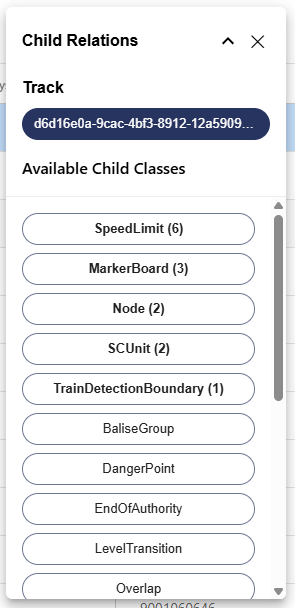
This will open a Child Relations panel on the right hand side. This panel displays a list of all the classes that can be related as children to the selected asset. Where a number shows against a class, this is indicating the number of existing assets for that class already related to the selected asset.

-
Click upon the child class you want to relate to the selected asset.
This will open the selected child class table (any existing relations will show highlighted at the top of the table). -
Locate the asset(s) you wish to relate by selecting their asset row(s), then right click and select 'Create Relation'.
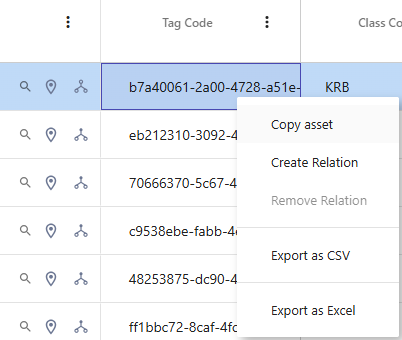
-
Within the dialog pop-up, select the relation type to use from those available.
-
Click 'Relate'.
-
When an asset is related to a Parent asset it's associated relation icon will update to provide a visual distinction that a relation is in place.
Viewing Asset Relations
To view the relations held against an asset, either:
Navigate to the asset within the Smartgrid table view and click upon the associated realtions icon for the asset. This will open the Child Relations panel on the right.
If the asset has parent asset relations in place, then table will expand to show parent assets in the immediate rows(s) below the asset.
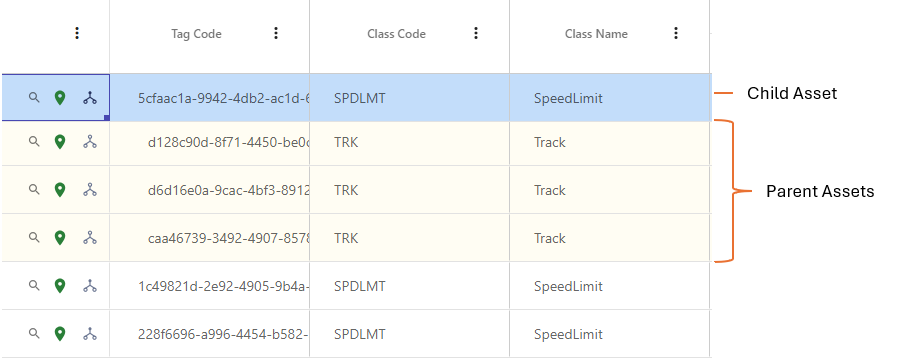
If the asset has child relations, the child counts are displayed against the classes within the child relations panel. Clicking a class will open the child class table with the related children highlighted at the top of the table.
Relating Assets via Asset Import
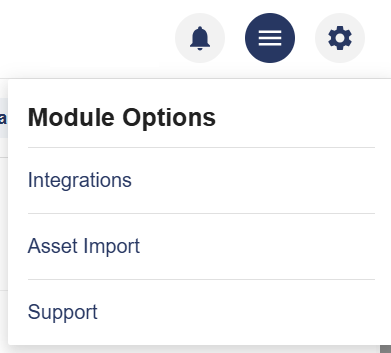
There is also the option to relate assets through using the Asset Import under Module Options.
Pre-requisites
Asset Import configurations need to exist for the classes of assets that are to be related.
These import configurations need to be set as Project Configurations and be grouped under a Workbook Configuration.
Configuring how to Relate Assets
Note that the worksheet columns that hold the key relation field values, do not need to be included import configuration mappings.

- Mandatory - 'Sheet Name': Enter the sheet name of the worksheet that holds the assets that will be the parent asset in the relation, within the 'Sheet Name' field.
- Mandatory - 'Key Field': Enter the column name that contains the unique key reference of the parent assets within the 'Key Field' field. The values in this column will be used as a lookup against the child assets foreign relation column.
- Mandatory - 'Foreign Relation Column': Enter the name of the 'Foreign Relation Column' that features upon the worksheet containing the child assets to be related and contains the corresponding unique references of the parent assets to be related.
- Optional - 'Target Sheet Name': To ensure the that only assets upon a specific import configuration sheet are updated with a relation, enter the sheet name within the 'Target Sheet Name' field.
- Optional - 'Relation Type': To ensure that a specific relation type is used to create the relations within the import, specify the desired relation type within the 'Relation Type' field.
It is possible to involve multiple relation updates within the same workbook import configuration by clicking the plus '+' next to the end of the relation configuration row.
Updated 18 days ago